Recall is a contest, and the park is winning
Recall is one job: making one word more valuable to your dog than everything else out there. Most people only ever work on the word. Better treats. A whistle. A long line. More reps. And it works, right up until a squirrel, a dog or a smell turns up that's worth more than your biscuit.
Here's the bit nobody tells you. There are two ways to win that contest. You can make the word more valuable, or you can make the outside world less desperate for your dog. The second one is easier, it lasts, and it's what the four things below are about.
"If your dog's recall is hit and miss, your walks are decided by luck."
1. Frustration: the root of the desperation
A frustrated dog isn't ignoring you. Something underneath is louder than you are. When a dog's day doesn't give them what their breed was built to do, they go looking for it outside, and they go looking hard. Every scent, every dog, every rabbit becomes the thing they've been waiting for all day. That's where the obsession comes from, and you cannot out-train an obsession with a recall word.
Picture this
Enzo walks perfectly on a lead everywhere. Everywhere except the path to the pet shop. There, he pulls like a train, because the pet shop is the best thing in his world.
Now ask yourself: does your dog see the whole outside world the way Enzo sees the pet shop? If the answer is yes, training is not the answer. Not yet.
So we flip it. Employ your dog, or they'll go self-employed. Give them their breed's outlet at home: scent games, a job, the chase they're built for, on your terms. A dog who isn't obsessing over things is a dog you rarely have to recall. And that keeps the word valuable for the moments that matter. The best way to ruin a recall is to use it for everything.
2. A proper vet check: pain hides behind "hyper"
A lot of behaviour problems are health problems wearing a costume. Sore joints, a bad tooth, a grumbling stomach, an ear infection. Pain creates stress, stress creates arousal, and an aroused dog is a frustrated, hyper dog who can't hear you. Roughly 60 to 65 percent of the behaviour problems I get emailed about, I send to the vet first. About half come back with something.
Why the normal check-up isn't enough
Most people take the dog in for an MOT. The vet looks in a couple of places, says "all fine," and nobody mentions how bad the teeth are or that one hip is stiff. So ask for the lot:
EarsEyesEvery toothSkinJointsNails and pawsAnal glandsTailBloodsWee and poo
And ask about a pain trial: a short course of pain relief to see if the behaviour changes. If it does, that's your answer.
I've had a member whose collie was reactive for two years, through three trainers. One proper tooth check later, a chipped tooth came out and the reactivity went with it. You cannot train through pain.
3. Your dog's window: beyond the walk
Most of us believe the walk gives a dog everything they need. For a few breeds, with a few hours a day, maybe. For most dogs, here's what actually happens.
Picture this
Your dog's whole day is a window. If the walk is the only time the window opens, your dog learns to empty the tank the second the lead comes off. Everything, at 110 percent, into that one hour, because it's the only hour they get. That's the dog who bolts out of the car, ignores you for the first ten minutes and comes back when they've run out of steam.
A walk doesn't have to be a walk. Farmers don't walk their dogs; the dogs have a day. Open the window wider at home: a job in the morning, scent work, a meal split into three and worked for, proper sniffing time, and then sleep. When the day provides, the walk stops being the only chance, and a dog who isn't desperate is a dog who comes back.
- Start one awake block with something hard for their breed, then wind it down to a chew and a sleep.
- Walk half the distance at half the pace. Get off the path. Let them sniff.
- Long line on the big walk while you fix the rest. It stops the ignoring being practised.
4. Diet: food fuels behaviour
Food isn't just energy. What's in the bowl changes the chemistry your dog is running on. Around 90 percent of a dog's serotonin, the calm, content, "I can cope" chemical, comes from their food. If the diet isn't producing it, you're asking a dog with no brakes to stop on a sixpence.
Fuel versus nitro
Think of food as fuel: it decides how long the car can keep going. Arousal is the nitro: the burst of adrenaline and dopamine that fires whether the tank is full or empty. Some foods spike that dopamine. So you get a dog who's wired, then a dog who's hungry and wired, and both of them are terrible at recall.
Get the serotonin side right and a lot of the "hyper" drops out on its own. It won't fix recall by itself, but it takes the edge off everything else you're trying to do.
My own dog: Enzo
What a mentor told me, and what Enzo taught me
Early on, a mentor told me something that stuck: "Recall is the only thing a dog needs. It's usually the one thing they don't have."
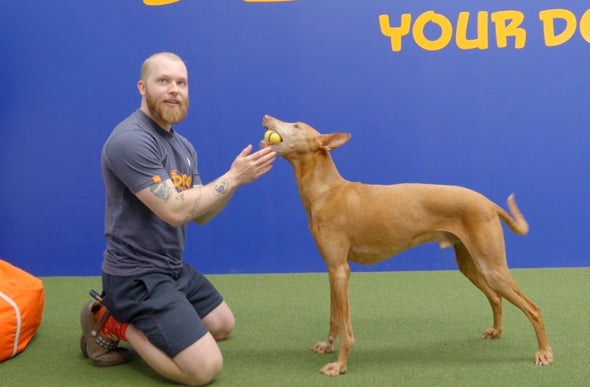
Then I rescued Enzo. A street dog, four years old, never had an owner. Hyperactive, obsessive, off in his own world on every walk. Recall training with him was a joke, and not because the training was wrong.
So I didn't train recall. I worked on the obsessions, the hyperactivity and what was going on in his head: his outlets, his sleep, his day.
Thirty days later he was off lead with a human for the first time in his life. The recall came after. It always does. He still chases every squirrel, by the way. I let him. I only call him when it matters, and that's exactly why it works.