
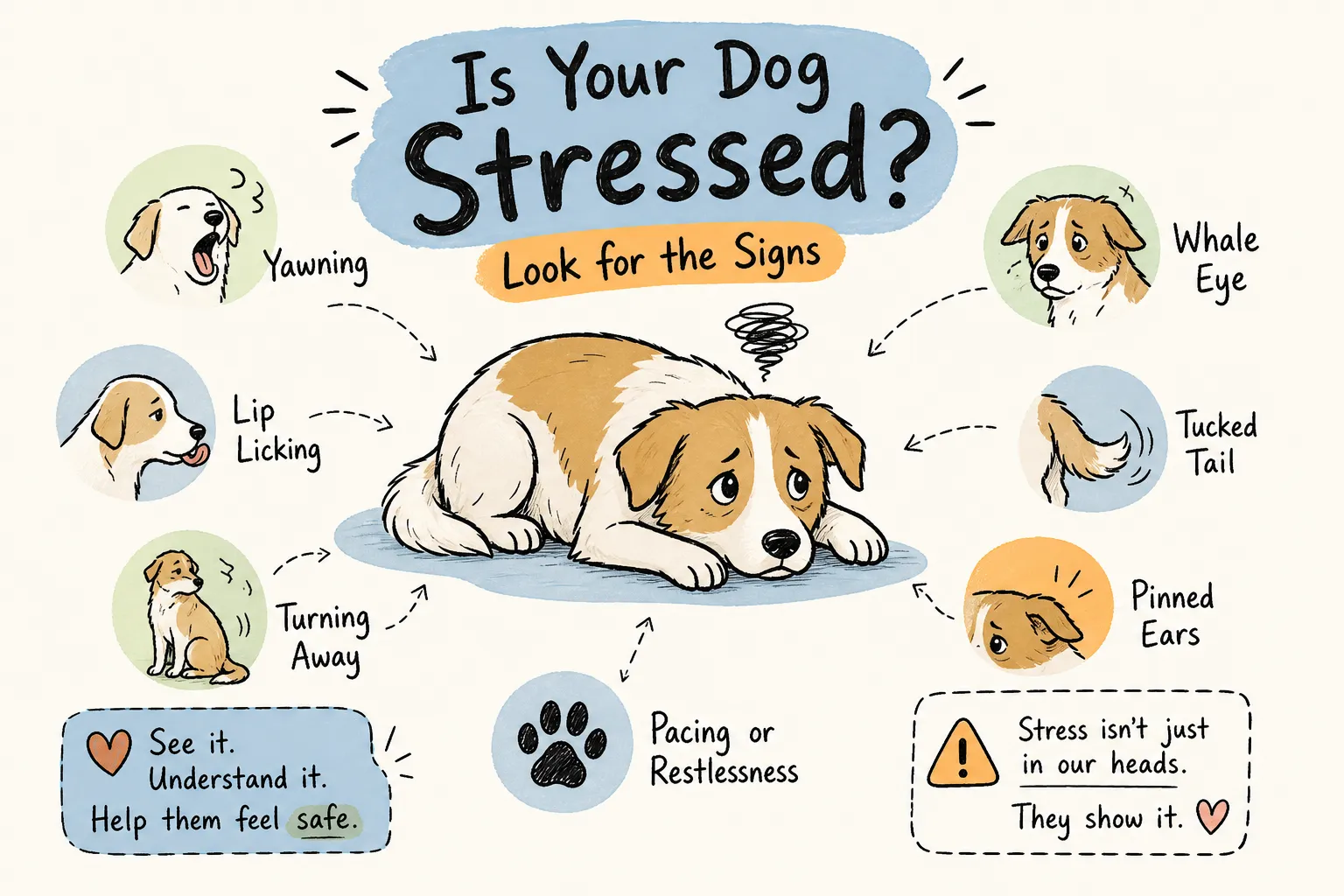
Your dog is already telling you they're stressed, just not with words. Eleven signals, from a quick lip lick to a full shutdown, show up long before the barking or the biting does. Catch them early and you've still got options. Miss them and you're managing a crisis instead of preventing one.
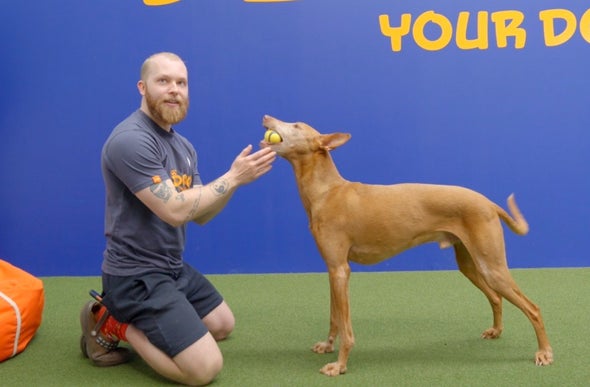 By Max Randall · IMDT Qualified · OCN Accredited · 1,000+ dogs helped
Most owners only clock stress once it's loud: lunging, snapping, trembling through a thunderstorm. By then, your dog has usually been signalling for a good while already.
A hard game of tug. Zoomies. The best walk of the week.
What this whole page is about.
That super happy, excited, bouncing off the walls dog every day can be just as stressed as an anxious dog. Don't assume a dog is okay just because they're happy. Hyperactivity is stress mode.
Eleven signals. Three groups, not all the same size of problem. Jump to yours:
Postural shifts most owners watch in broad strokes instead of clocking specifically.
The head turns away but the eyes stay on it, showing a crescent of white you wouldn't see relaxed. Your dog is uncomfortable with what's in front of them and choosing not to face it head on.
Held flat and low, not just rotated back in curiosity, usually with the head dropped slightly too. On floppy-eared breeds, watch the base of the ear and the overall head carriage instead.
Tail tucked low, weight shifting backward, the whole body turning away. A dog that suddenly looks poured into concrete is often the very first sign, before anything else shows.
Not rest. A resting dog is loose and comfortable. A frozen dog is stiff and still, eyes fixed, mouth shut tight, out of other options and gone very still as a last resort.
Ordinary-looking actions performed out of context as a pressure valve. That's exactly why they get missed.
A tongue flick with no food anywhere nearby, especially mid-greeting or mid-training. It's a genuine calming signal, not hunger. Context tells you everything.
A tired yawn is loose and slow, in a warm room after a walk. A stress yawn happens mid-session or mid-vet-visit, tight body, alert eyes. Same action, different animal underneath it.
Sudden nose-to-floor as another dog or person approaches isn't distraction, it's self-regulation. Correcting it for "not listening" removes a tool your dog is actively using to calm down.
Rapid, shallow breathing with no exercise behind it. The tongue usually isn't hanging out much unless your dog is genuinely hot. If the breathing sounds like they've just done a lap of the park but they're actually stood still, that's stress, not exertion.
One of these on its own is close to meaningless. A yawn, then a lip lick, then a half turn away, all inside ten seconds, means something.
Arousal doesn't create these behaviours, it just exaggerates what's already underneath. By this stage, your dog has usually been signalling for a while.
Pacing, whining, vocalising that won't interrupt even when you try. Different from a dog asking for attention who stops once ignored. A nervous system stuck switched on.
Not the same as the freeze in sign 4. A dog refusing food, refusing to move, not responding to cues you know they know. Past the point of learning anything right now.
Compulsive licking or chewing at their own body, toileting under stress, going off food. Get the vet involved. This isn't something to train your way out of alone.
About 60 to 65% of the behaviour emails I get, I send straight to a vet. Roughly half come back with something found. If your dog has gone quiet, stopped eating or shut down completely, that's not a training day, that's a vet day. Nothing on this page replaces a proper vet check or, where there's any bite risk, an in-person qualified behaviourist.
In the moment, your only job is space. Here's the short version:
If this keeps happening, it's not a one-off moment, it's a pattern. A dog who can't settle, or who's constantly licking or chewing at themselves, is showing you what chronic stress looks like day after day. That needs a lifestyle fix, not a technique for the moment you're stood in:
Dogs are a direct result of the lives they're living. If yours is stressed like this regularly, something in that daily life needs to change, not just the next five minutes.
A dog who's regularly stressed, or regularly hyperactive and bouncing off the walls, needs two things: more fulfillment, and more sleep. Skip either one and it doesn't just stay where it is. It snowballs, into behavioural issues that training on its own can't manage anymore.
If that's where your dog's at, the fix starts with understanding why, not another training technique. That's the whole idea behind Don't De-Dog Your Dog, the philosophy this entire platform is built on.
See What Don't De-Dog Your Dog Means →7-day free trial · Bare Hands money-back guarantee
The ones owners actually ask me, answered straight.
The Whole Dog Approach starts with seeing what's actually going on, then resolves what's underneath it, so the same stress doesn't just resurface as something else.
Start Your Free Trial →Rated Excellent on Trustpilot · IMDT qualified · OCN accredited
Written by Max Randall, IMDT-qualified and OCN-accredited dog trainer · More free dog training guides · Related: Separation Anxiety · The philosophy: Don't De-Dog Your Dog · FAQ