
Most dog training splits into two families: reward-based (positive reinforcement, clicker and marker work) and aversive (balanced training, e-collars, prong and slip leads). The research is consistent: reward-based is as effective or better, with far less fallout. But here is the part almost no method addresses. The behaviour you are fighting is usually a symptom, not the problem.
That's the short version. Here's the whole thing:
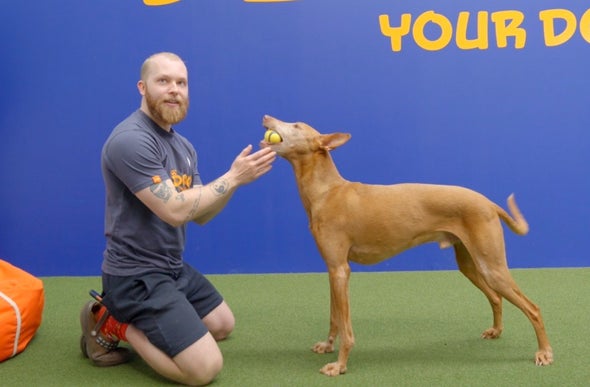 By Max Randall · IMDT Qualified · OCN Accredited · 1,000+ dogs helped
Every method, what it costs your dog, and the bit nobody mentions
Before you compare brands and names, know this. All dog training is made of four things, the four quadrants. Positive means you add something. Negative means you take something away. It has nothing to do with good or bad. We use two of them. The other two work by making your dog uncomfortable. Tap any card to see which is which.
Add something the dog wants the second they get it right, so the behaviour happens again. Nose touches your hand, they get the food.
This is the engine of everything at MK9Plus. The dog chooses to work because working pays. Nothing to suppress, nothing to fear.
MK9Plus uses thisTake away something the dog wants so a behaviour fades. They didn't do the thing, so the food doesn't come. Or you calmly walk away.
One of these two is always happening. They got it right and the reward appears, or they didn't and it doesn't. No pain, no discomfort, just clarity.
MK9Plus uses thisAdd something the dog hates to shut a behaviour down. A lead pop, a jab, a shout. The behaviour stops, at least in front of you.
Behaviour is communication. Punish it and the message goes quiet, but the feeling underneath is still there. Dogs trained this way show more stress, higher cortisol and pessimism around their handler.
MK9Plus does notRun discomfort until the dog complies, then stop. Take the bad feeling away as the reward. This is how an e-collar teaches.
You call, the collar stings, the dog comes back, you cut the sting. They learn because otherwise it keeps hurting. That is not a relationship, it is a threat.
MK9Plus does notIn plain terms: we use positive reinforcement and negative punishment, because neither one hurts your dog or creates new problems down the line. The other two get their results through discomfort, and discomfort has a bill that turns up later.
Every name you have seen advertised is really one of these five. Here is how each one works, and the catch nobody puts in the sales pitch.
"Prongs are for pricks. We don't want to hurt dogs, or force our goals upon them. That's not training, that's forcing."
No hard sell. Take the tour of what is actually inside MK9Plus and see the approach for yourself, then decide.
See what's inside →7-day free trial · money-back Bare Hands Guarantee
People assume aversive tools are the "serious" option that gets faster results. The research keeps finding the opposite. Three studies worth knowing:
A review of seventeen peer-reviewed studies concluded that aversive methods are linked to increased welfare and behaviour risk, that reward-based methods should be preferred, and that there is no evidence aversive methods work better. Some of the studies found reward-based training worked better.
Ziv (2017), Journal of Veterinary Behavior. Read the review
When researchers compared dogs trained with e-collars against dogs trained with rewards, the reward-trained dogs responded faster to cues like recall and sit, and showed fewer signs of stress. The "you need the collar for reliability" argument did not hold up.
China, Mills and Cooper (2020), Frontiers in Veterinary Science. Read the study
Companion dogs trained with aversive methods showed more stress behaviours during training, higher cortisol afterwards, and were more pessimistic in a cognitive bias test than dogs trained with rewards. In plain English, the method changed how the dog saw the world, not just how they sat.
Vieira de Castro et al. (2020), PLOS ONE. Read the study
There is a thread running through all of it. When a household leans on two or more aversive tools, the dogs are more likely, not less, to show fear and owner-directed aggression. You can suppress a behaviour with a tool. You cannot suppress the feeling that caused it, and that feeling has to go somewhere.
Same five approaches, five columns: how it works, the main limitation, what the research shows, and where each one sits with me.
| Method | How it works | Main limitation | What the research shows | The MK9Plus view |
|---|---|---|---|---|
| Positive reinforcement | Add something the dog values the moment they get it right | Slower if timing or mechanics are off, and the dog must be under threshold | As effective or better than aversive (Ziv 2017, China 2020) | Our foundation, paired with negative punishment |
| Clicker / marker | A click or word marks the exact moment, then the reward follows | A precision tool, not a fix on its own | Same evidence base as reward-based training | Precision positive reinforcement, not a separate camp |
| Balanced training | Rewards plus corrections and tools | Suppresses symptoms, welfare fallout, unregulated label | More stress and cortisol, more pessimism (Vieira de Castro 2020) | Traditional training with a nicer name |
| E-collar | Discomfort until the dog complies, then relief | Pain-based, suppresses communication | Reward-trained dogs obey faster (China 2020) | Negative reinforcement, we do not use it |
| Root cause (Whole Dog Approach) | Resolve the stress, arousal, sleep, needs and pain behind the behaviour | Asks more of the owner up front, vet first for pain | Addresses the cause the other rows leave untouched | The whole point: fix the life, not the dog |
A solved problem is one you never have to go back to. Solve it with punishment, and one day you will have to punish it again.
Max Randall · MK9Plus
On the evidence, reward-based beats aversive and clicker work is just reward-based done well. But method is downstream of cause. The calmest, most reliable dogs are not the ones trained hardest. They are the ones whose life was sorted first. Here is what "the cause" usually is:
An under-slept dog is a wired dog. Most "hyperactive" dogs are simply exhausted and cannot switch off.
A dog living permanently over threshold cannot learn, cannot take food, and reacts to everything. No cue fixes that.
Breed-specific outlets, sniffing, chewing, real decompression. Block what a dog is built to do and you get frustration.
Pain is behind a huge amount of "naughty". A dog that hurts is a dog on a short fuse. Vet first, always.
Sort those out and most of the behaviour you were trying to train away simply stops being created. That is the whole method. Training is the last 10%, not the first.
See the approach →The best method is a calm dog whose needs are met, taught with kindness. That is the whole of MK9Plus, and you can try it free.
Start with the philosophy →Rated Excellent on Trustpilot · 7-day free trial · money-back guarantee
Written by Max Randall, IMDT-qualified and OCN-accredited dog trainer, founder of MK9Plus. Part of the free written guides.
Sources and further reading: Ziv, G. (2017). The effects of using aversive training methods in dogs, a review. Journal of Veterinary Behavior. Link. China, L., Mills, D.S., Cooper, J.J. (2020). Efficacy of dog training with and without remote electronic collars. Frontiers in Veterinary Science. Link. Vieira de Castro, A.C. et al. (2020). Does training method matter? Evidence on the welfare impact of aversive-based methods. PLOS ONE. Link. Method framing from Max Randall's MK9Plus lessons: The Four Quadrants, What Is a Marker Word, and Everything Lead Walking. E-collar legislation status current at time of writing, confirm your local law.